
Public Theology: The People of God in Exile

Citizens of the Kingdom of God but Residents of Earthly Kingdoms
As Pastor Todd is showing us in our sermon series on Daniel, the place where God’s kingdom and the kingdoms of earth meet is a place of exile. We who live in both kingdoms long to be in our true homeland, in the presence of God, but find ourselves in a strange land on which we depend for our security, peace, and even lives. We are citizens of the kingdom of God but residents of earthly kingdoms.
This condition of the people of God, exemplified by the exile of the Jews (like Daniel) in Babylon, was the touchstone of the most influential piece of public theology outside of the Bible in all Christian history: Augustine’s City of God. Augustine thought the Babylonian exile was providentially arranged to picture for Christians what it means to be pilgrims or resident aliens in the earthly city. Peter Brown, in his biography of Augustine, writes that “the City of God, far from being a book about flight from the world, is a book whose recurrent theme is ‘our business within this common mortal life.’”
Understanding our business as Christians within common mortal life is no easy task. For one thing, the two cities—the human city and the city of God—operate with different motivations and goals. Augustine saw the disconnect between them as arising from a distinction between rightly ordered loves and disordered loves. It is not primarily that one city is spiritual and the other material, or one eternal and the other temporal. Rather, the citizens of the city of God love all created things for the sake of the creator. They love as recipients of the gifts of God. The citizens of the human city, however, love created things for the sake of the things themselves, so their love turns into envy, lust to dominate, and—above all—pride.
The Two Cities
It is worth stressing that the features of the two cities are the same. They share the same goods, like peace, beauty, justice, and human relationships. They are both social communities, with culture, art, and politics. It is also important to understand that the city of God is not identical to the church. The dividing line between the two cities is invisible; the citizens of both live side by side in the human city.
But in the human city the citizens seek peace, beauty, justice, and human relationships for selfish purposes; and they seek peace through violence, justice through cruelty, beauty through exploitation, and human relationships through manipulation. Therefore, how should the citizens of the city of God, exiles in the human city, think about those goods that surround them? Are peace, beauty, justice, and relationships in the earthly city so tainted by earthly purposes and means that they should be avoided altogether? Should they be fully embraced? Something in between? For instance, how far should Christians go to achieve justice in the earthly city? How important are those efforts in God’s sight and to the Christian life? Is earthly justice even the same kind of justice that Christians long for?
These are the questions asked by public theology. Public theology analyzes cultural, social, economic, and political arrangements from the perspective of God’s way with the world.
Five Lenses through which Christians Have thought Christ Views Human Culture
One approach to these questions is through the famous, if greatly oversimplified, typology in H. Richard Niebuhr’s Christ and Culture. Niebuhr sets out five general ways in which Christians have concluded that Christ’s rule of the heavenly city relates to human ideas, practices, and systems that make up a society and its culture in the earthly city. In other words, these are five lenses through which Christians have thought Christ views human culture and therefore how his followers should view it as well:
- Christ Against Culture. In this view, the church is an alternative community, and its task is to condemn sin in all other social arrangements. Christ has sole authority over the Christian. Any claim to loyalty by the culture or any part of it must be absolutely rejected.
- The Christ of Culture. This is the opposite view, in which no tension arises between the church and other social arrangements. The task of the Christian is to conserve what is good in culture and improve what is not yet wholly good.
- Christ Above Culture. The church, according to this view, should be the governing power in the world, because Christ’s successors exercise his lordship over all things in his place. The church is responsible for the world.
- Christ and Culture in Paradox. The Christian, viewed through this lens, is guided by different principles depending on the sphere is which he or she is functioning. The Christian lives by spirit as a citizen of the eternal kingdom (i.e., by a deep personal relationship with Christ) but by technique in relation to temporal things. Law restrains evil in both church and world.
- Christ the Transformer of Culture. The church should be a beacon to the world and an example of the possibility of transformation and redemption. The Christian is a transforming agent. Law not only restrains evil but fosters good.
These lenses are not mutually exclusive. Perhaps it helps to reflect on which one(s) resonate with you and seem most faithful to the call of Christ in your life.
In the next post, we will consider how the various approaches to Christ and culture can play out specifically in political theology—which is one kind of public theology and is central to the book of Daniel, with its dramatic rising and falling of earthly empires.
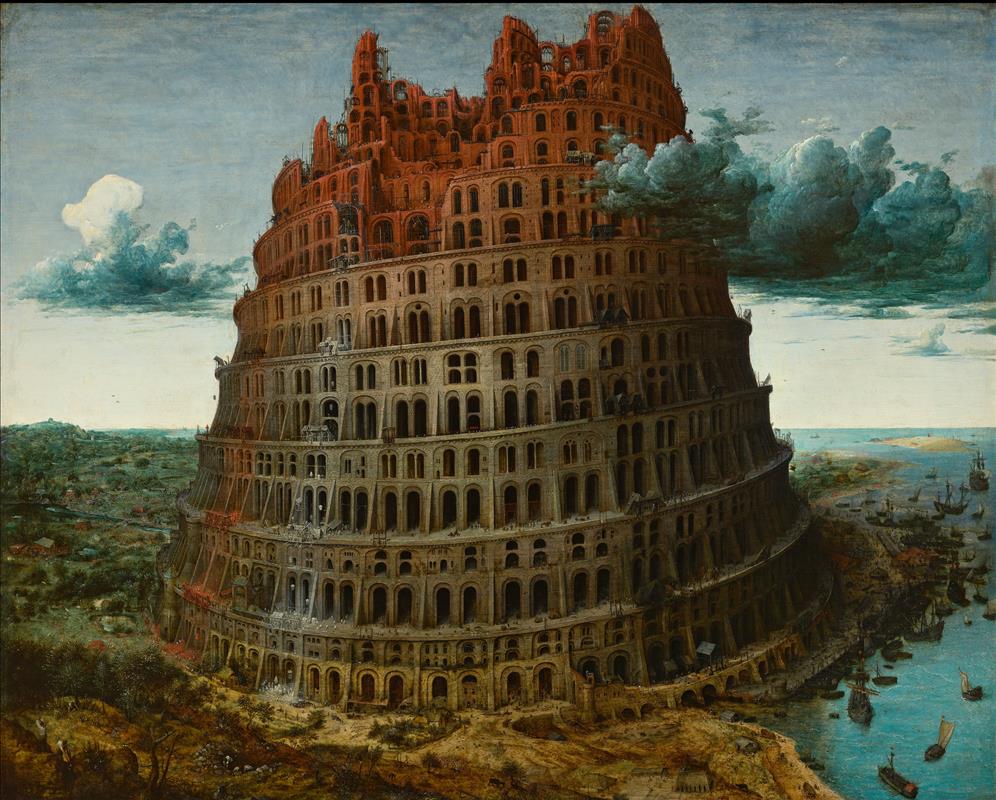
Title image: The “Little” Tower of Babel , Pieter Bruegel the Elder, 1563